
Decoration Techniques

EMBROIDERY

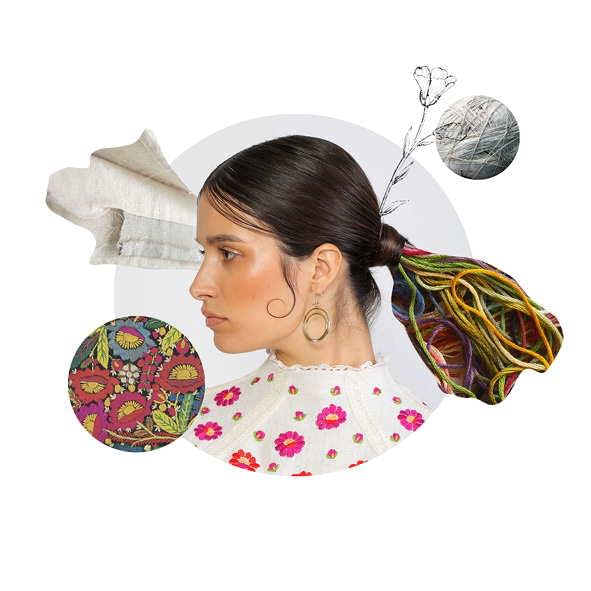
Embroidery is a textile craft through which women could express their imagination and creativity and shape their own visual language. Clothing was decorated with embroidery more than any other kind of object. The materials embroidered included linen and silk fabrics, woollen cloth, purchased felt, as well as knitted wool and leather. Embroidery was worked with home-spun or purchased wool and with gold and silver thread. There are two basic methods of embroidery. Counted-thread embroidery is worked by counting the threads of the ground fabric. Free-style embroidery flows freely and is laid onto the ground according to a drawn or imagined motif.

Embroidery could be worked in white thread or in colour, and the choice of colours carried a special symbolic meaning. Until the last decades of the nineteenth century, women dyed embroidery thread themselves with plant dyes, which gave the finished pieces a calm, subdued character.

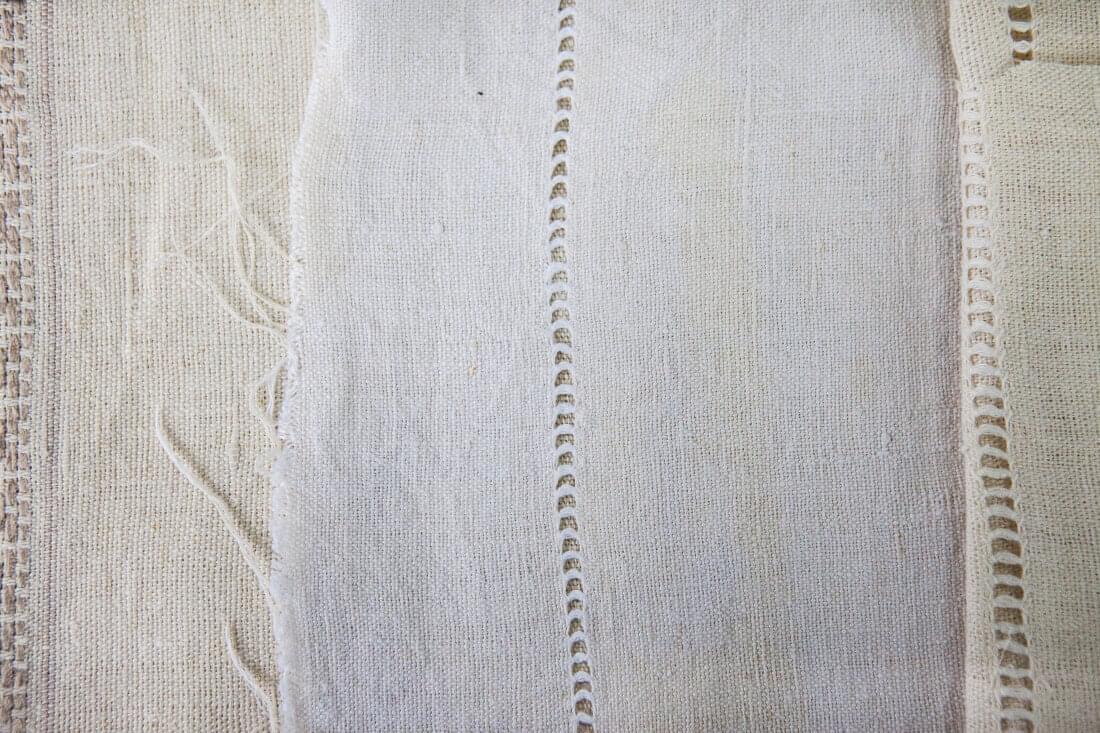
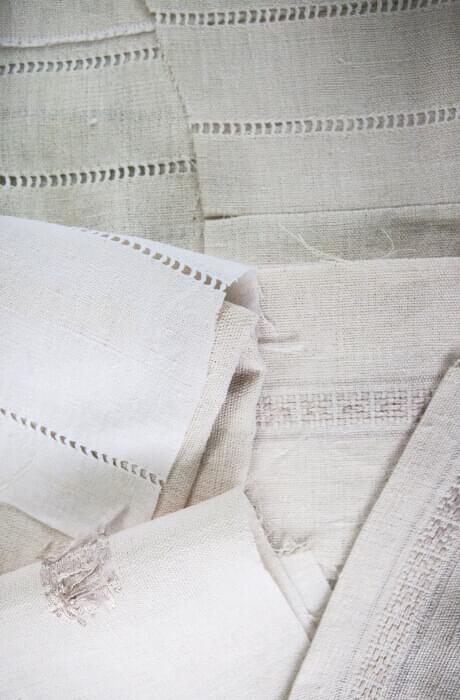
A special type is whitework embroidery, whose technique is close to decorative openwork. In whitework, open motifs are formed on the threads of the linen and edged with white cotton thread. They often serve as decorative seams joining two pieces of cloth.

In mountain regions embroidery was also worked with silver wire—srma—and in Slavonia with gold as well.
LACE

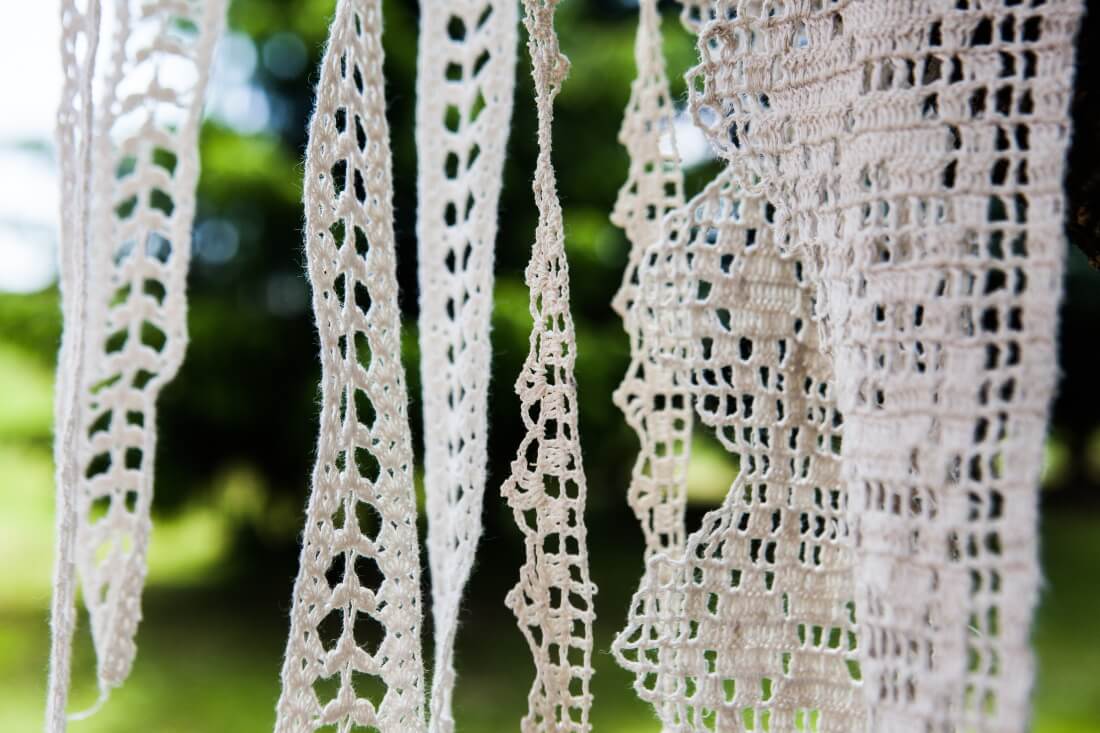
Lace is an independent openwork handicraft made from linen, cotton, silk, agave, silver or gold threads. The two basic techniques of making lace are needle stitching and plaiting with bobbins. This craft rests on embroidery and on the knotted intertwining of threads. Netting, knitting, crochet and machine-made lace are also counted among lacework.

NEEDLE LACE

The first laces appeared in the Renaissance. Early needle lace grew out of so-called whitework embroidery—sewn drawn-thread work and filling stitches. In drawn-thread work a certain number of weft threads are withdrawn from the fabric, while the remaining parallel threads are wrapped with needle and thread and tightened to form particular patterns. The filling stitch is in fact a buttonhole (air) stitch.

With needle and thread a small knot is formed that always continues onto a taut cross thread or the stitch of the previous row. Drawn-thread work is bound to the vertical and horizontal threads of a geometrically drawn ground, while buttonhole stitch builds the intended ornament more freely.
BOBBIN LACE

Bobbin lace developed when the free warp threads, after the cloth was taken off the loom, had to be secured—that is, interlaced with one another—so that the fabric would not unravel. As the plaiting technique developed, the threads were at one point, for ease of working, wound onto holders—bobbins of lead, bone or wood.

Needle lace requires a needle, thread and a support in the form of a round or curved, firmly stuffed cushion. For bobbin lace, besides the cushion support, an even number of bobbins onto which the thread is wound is needed, as well as pins that secure the worked part of the pattern row by row.

Examples of the earliest needle lace in Croatia can be found on white linen garments such as women’s shirts in the area from Istria to the Dubrovnik coast. In central Dalmatia we find examples of more complex ornaments—reticella, small nets of threads. Around the reticella, the desired ornaments are worked in buttonhole stitch.

Women’s head coverings were also decorated with whitework, occasional drawn motifs and, in places, a decorative band of early reticella together with an edging of bobbin lace.

PAG LACE

Pag lace, a needle-made lace, is worked with whitework, cutwork, drawn-thread work and filling stitches. Also well known is the Pag teg—an ornament worked in needle-lace stitch in the form of early reticella, with geometric motifs: a small filled or open circle; a smaller or larger circle; a semicircle; a small triangle; a rhombus; a rectangular or triangular leaflet; zigzag bands; and a true or false four-petalled rosette. Small edge circles give the overall design its airiness.

LEPOGLAVA LACE

In earlier times bobbin lace was more widespread in Croatia than needle lace. Bobbin-lace edgings accompany linen textiles throughout Croatia. In more recent history they are associated with the north-western part of the Pannonian region of Croatia—Podravina, Međimurje and Hrvatsko Zagorje. One of our most important centres of bobbin lacemaking is Lepoglava.

Around the year 1400 the Pauline fathers brought lace to Lepoglava. Over time lacemaking also became a distinctive form of folk creativity. In shaping the lace, geometric motifs of narrower or wider bands are used, ranging through to Baroque stylisations of floral patterns.

AGAVE LACE

In our country we also encounter another speciality: lace made from agave. According to tradition the skill originated in the Canary Islands, and it has been present on Hvar since the mid-nineteenth century. Today it is made only by the nuns of the Benedictine monastery in the town of Hvar. The lace is worked from threads obtained by a special process from the centre of fresh agave leaves. After processing the threads are white, quite fine and of a fixed length. By technique we distinguish lace called tenerifa, tenerifa with netting, and frame netting. Tenerifa is worked on cardboard: first a ground is made in the shape of a radial spider’s web. Then, with a needle, various mostly geometric ornaments are interlaced around the ground threads. Agave lace is made without a pattern or drawing. Each piece is unique.

FOLK VISUAL EXPRESSION

The visual expression of Croatian folklore is not uniform, and it is hard to grasp as a whole because of the diversity of cultural regions and of regional and local specificities.

At the turn of the nineteenth to the twentieth century, under the influence of the urban environment, greater changes came about in traditional culture and in visual expression as well.

Textile handicrafts, examples of which we find on clothing and other textile objects used on the rural farmstead, were almost always made by women.

Numerous techniques of embroidery, appliqué and lacemaking were a very important finishing process through which the distinctive appearance of folk costume was achieved.

We regard as more archaic those methods of decoration carried out during the weaving process itself, while techniques of decoration worked in embroidery with cotton, wool or silk, and decoration with braids and pieces of leather, we regard as more recent.

The precise making of individual ornamental details and the colouristic and ornamental rhythmisation in many examples testify to the high creative and aesthetic achievements of local women.
Different materials, techniques and local particularities are linked by an almost unified principle of ornamental design. Flat design, symmetry and geometric ornament predominate (parallel lines, zigzag motifs, rhombuses, curved lines, the “S” motif and spirals in various combinations, and the motif of the rosette and circle).

Geometric and geometrised ornaments are most often composed in a horizontal row, and sometimes within a circular field. The basic method of composition is a uniform sequence created by repeating the same motif or by the rhythmic alternation of groups of motifs, especially on woven and embroidered decorations and on lace.

Plant and animal motifs are stylised to varying degrees. The plant motifs that appear most often are flowers and twigs in various compositions. The heart motif and Christ’s monogram IHS are attributed to Baroque influence.

Zoomorphic motifs range from strongly geometrised variants to some almost realistic interpretations.

The human figure is a relatively more recent and rare motif.

The colours most often used are achromatic combined with primary colours.

Folk costume and the motifs that decorate it express a deeper unreal–magical meaning as well as a particular social significance. Folk visual works need to be viewed within the traditional culture in which they arose. Folk costume is an indicator of an individual’s status in the village community and of a particular stage of life or event.

Colours also have their traditional meaning in dress. Girls, brides and young women wore an abundance of red ornaments to protect themselves from evil forces and to secure a happy future. Women who had become mothers of several children wore more subdued colours. The older a woman became, the simpler the ornaments on her clothing. In the central lowland region, white clothing without ornament was worn in mourning.

The ornaments used for decoration have their own symbolic meanings. Motifs need to be seen within the complete object—the whole composition that decorates it.
Linen

LINEN IN CROATIA, PROCESSING RAW MATERIALS AND PREPARING FIBERS FOR WEAVING
FLAX

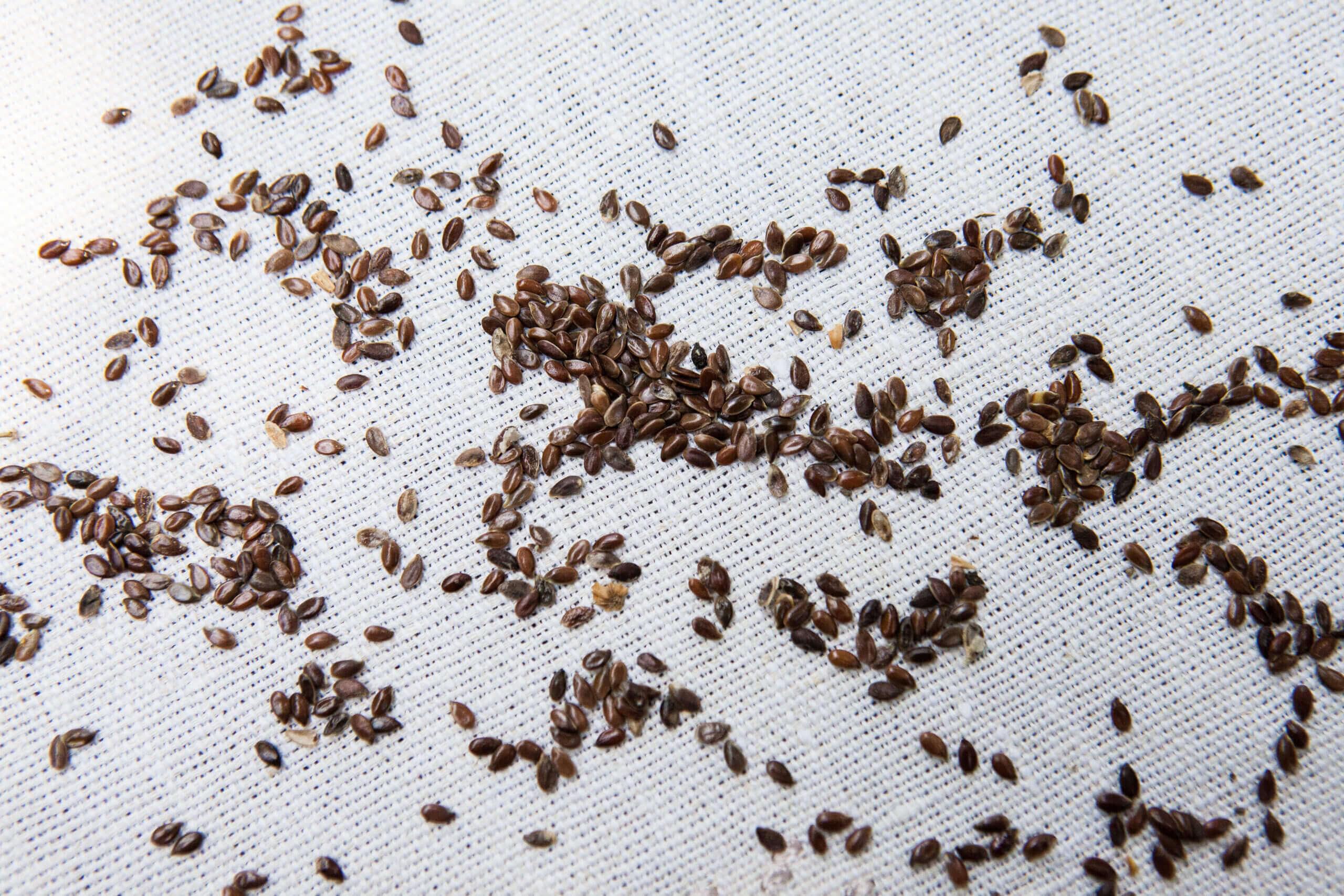
Flax is an annual plant from the family Lanova Linaceae counting more than 200 annual and perennial species. Some are grown for fiber and some for oil. The fiber is obtained mainly from the stem of the blue flax plant.

Flax fibers are considered to be one of the strongest natural fibers and are even stronger when wet. They absorb moisture and water exceptionally. Cellulose is the main ingredient of flax fiber. The chemical properties of flax correspond to the chemical properties of cellulose. Flax fibers are highly valuable in the production of summer clothes, beddings and tablecloths.

For more than 10,000 years we have known flax. The earliest findings of flax seeds have been discovered in Mesopotamia and in the area of present-day Iran. Findings from ancient Egyptian tombs testify that the Egyptians also cultivated and processed flax from ancient times. Around 500 BC Kr. flax was familiar to the people living in the area known as today’s Germany, Belgium, and the Netherlands. In the period from 16th to 18th century linen production and flax processing reached its peak, in Europe. In the 18th century along with wool and hemp, linen was the most important raw material for textile.

Flax fiber used as textile and food was important until the end of II. World War when artificial fibers production started which led to a continuous decline in the interest of linen fibers production. Today, flax seeds are mostly produced in North America while fiber production remains in Europe. Efforts to resume flax cultivation to obtain fiber and seeds are being re-encouraged.

FLAX IN CROATIA

The first written testimony about the processing of linen fibers in Croatia dates to 1720, when the first linen weaving mill was opened in Ozalj. From statistical data it is evident that at the beginning of the 20th century flax was planted on approximately 7000 ha of land. After World War I, areas where flax was cultivated were in constant decline. In the 1940s and post-war years, industrial linen production almost disappeared. Nevertheless, many farms have continued the tradition of growing flax and processing linen for their own needs. In Croatia, since the 1950s, due to the emergence of cheaper textile fibers and the abandonment of traditional clothing, areas planted with flax have been continuously decreasing. At the end of the 20th century, they were reduced to 650 ha. After the Homeland War, the only remaining factory for industrial linen processing was closed. In 2000, an initiative was launched for the renewal of flax culture in Croatia, possibilities of revitalizing flax cultivation, processing into fibers and restoring traditional hand weaving were explored.

HOMESTEAD LINEN PROCESSING

In the past, most of the clothing for the family, as well as beddings, was produced at home. Raw materials for making canvas were made on the estate. Production consisted of a whole range of different jobs. Linen from Posavina is the highest quality linen which can be produced in Croatia.
Mature plants were stacked in bundles and seed heads were torn off by dragging them over a large wooden comb. To separate the fibrous part, the stems were immersed in water, where they soaked for 5-10 days. The were left out in the dew for the same purpose. Then, they were stacked in piles and left to dry in the sun or in yard ovens. Dry and heated bundles were further processed by threshing. For this, they used a pillar, a device that raises and lowers the toothed lever by pressing the foot and striking the arms, placed on the lower, also toothed part. The fibrous parts are then cleaned using friction in a hand-held threshing machine, composed of a wooden knife inserted into a gap between two longitudinal planks. This completely frees the fiber from its woody waste. The fiber yet needs to be cleaned by pulling over the ridge, a tool with iron teeth. The finer and longer fiber is separated from the coarser and shorter. By applying these processes, the combed fiber was prepared for spinning.

PREPARING THE LINEN FOR WEAVING

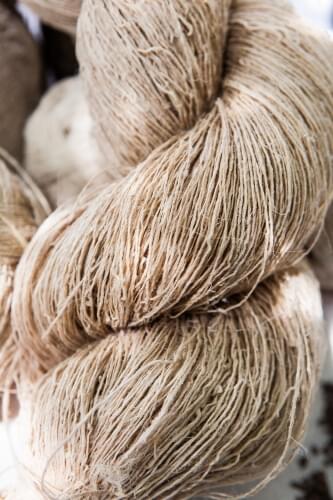
By spinning, the textile thread is created from the fibers. With one hand the spinner pulls out small batches of fiber, moistens them using saliva and twists them, while with the other hand she turns the distaff (preslica), a special wooden base. Women often did this while walking, with a distaff tucked to the left side of the skirt. Women used to spin while sitting, they also used a spinning wheel. In the area of central Croatia, spinning was done without using a distaff, here the spinning was done by tying the fiber to one’s own head.
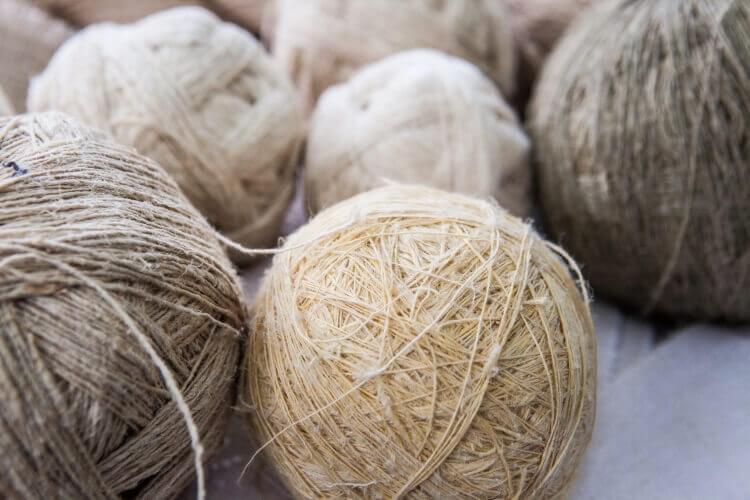
Distaff was an important item for rural women, one of the few items of personal property they had. In the Croatian area, there were about ten types of distaffs in use, all of which were differently shaped and decorated. The yarn was rewound from the spindle into coils via a T-shaped tool, a raška. The size of the fabric was also defined by counting the threads on the raška. The coils were suitable for bleaching yarn. The yarn was boiled in hot water with wood ash. The bleached coils were then wound into a ball again.

LINEN WEAVING

Weaving consists of intertwining of two systems of threads: longitudinal (warp) and transverse (weft). Preparing the basics was a complex job. It was necessary to determine the width and length of the fabric when winding, and then to cross the threads so when introduced into the loom, they could be immediately separated into even and odd numbers. In Croatia, a loom with a horizontally laid base was what was mostly in use.
The horizontal loom consists of the sides of the loom, the base roller, the cloth roller, the healds, the loom, the pedal, the shuttle, the heald frames.
Weaving on a horizontal loom is generally performed by two weavers. The most important thing is warping and pushing the threads into the healds and the shuttle. When warping, it is necessary to make a cross shape out of threads which are transferred to the base roller. One weaver adds the threads in the exact order and places them first into the healds in this order: 1.2.3.4.- 4.3.2.1. The other weaver holds the threads and places them into the shuttle in the same order. Then the warp threads are tightened evenly and fastened to the base roller. By pressing the caps in the order 1.2.3.4.- 4.3.2.1. the healds alternately rise and create a yawn of thread into which the weft is inserted and pushed down the shuttle.
Weaving was mostly a woman’s job. Women produced the basic material for making clothes and all other household textile necessities, reaching an enviable aesthetic level in its decoration. Different weaving techniques were used in Croatia. Among the simplest is weaving for canvas, where one warp thread is intertwined with one weft thread. When the weft threads completely cover the warp, a dense weave is formed. Weaving with a stepped structure was often used. Emblem weaves are complex monochromatic weaves with different patterns. By inserting another type, different thickness or color of yarn, plaid weaves are created, with a looser base, thus creating pleated striped fabrics. Among the decorative techniques, strumming was freely applied. To create the motifs, they ran their fingers or a small wooden board across the threads.
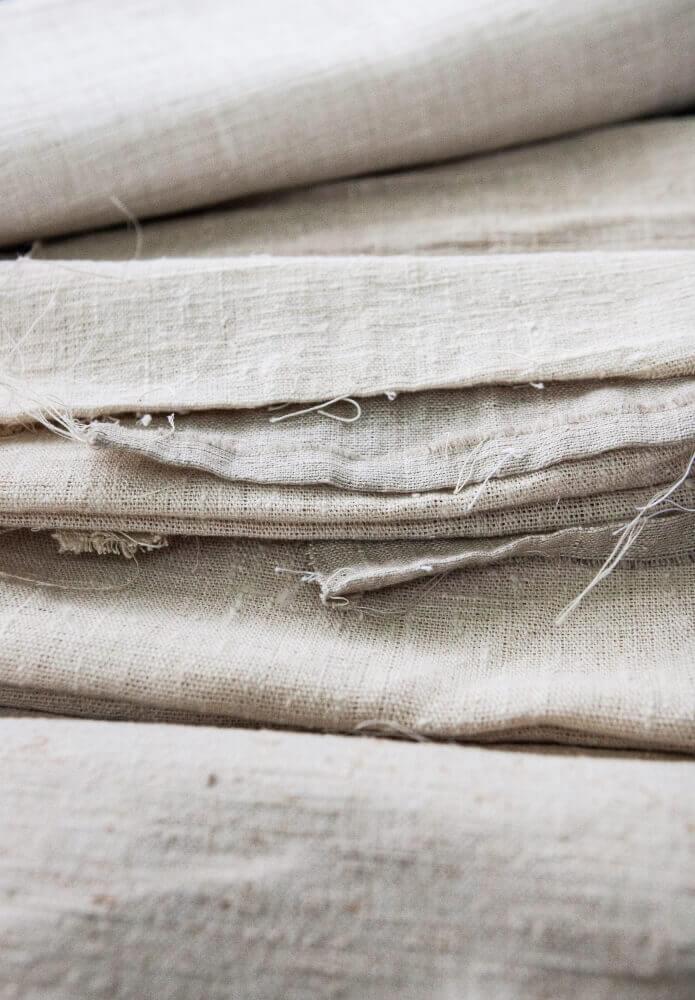
In central and lowland Croatia, clothing was mostly made of home-made linen or hemp cloth. The national costumes of Turopolje, Posavina and Moslavina are characterized by a fine linen cloth with a silky sheen. The motifs that adorned the garments were geometric or stylized herbal motifs. Later, under the influence of the Baroque era, they were modified into floral motifs.
Geometric motifs that mostly appear on woven and embroidered ornaments and lace are parallel lines, zigzag motifs, rhombuses, motifs of curved lines, spirals in various combinations, rosettes, and circular motifs. Geometric motifs mostly appear in a horizontal sequence. The basic way of composing is a uniform sequence which is created by repeating the same motif or rhythmically changing a group of motifs. Herbal motifs most often appear as flowers and twigs in various compositions.
Motifs appearing on folk costumes, in addition to artistic significance, also have a mystical and a certain social meaning.

EMBROIDERY

Embroidery is a textile production skill which allowed women to express their imagination and creativity and model their own artistic expression by. Clothing was mostly decorated with embroidery. The materials used for embroidery were linen, silk fabric, cloth, knitted wool and leather. The embroidery was made with domestic or purchased wool and gold and silver wire. There are two basic ways to do embroidery. Counted thread embroidery is performed by counting the substrate threads. Outline embroidery is free flowing, placing it on the base and aligning with the drawn out or imagined character.
A special type of embroidery is whitework embroidery, with its technique closer to decorative knitting. In whitework embroidery, hollow motifs are created on the threads of the canvas, wrapped in white cotton thread. They are often used as a decorative seam that connects two parts of the fabric.

FOTO by Ana Šesto

Sources:
1. Vitez, Zorica i Muraj, Aleksandra Hrvatska tradicijska kultura na razmeđu svjetova i epoha. Barbat naknada, Zagreb 2001.
2. Ivanković, Ivica i Šimunić, Vladimir Hrvatske narodne nošnje. Multigraf naknada, Zagreb 2001.
3. Pleše, Adela Hrvatski narodni vez Uzorci vezova i tkiva sjeverne Hrvatske. Naknadni zavod Hrvatske, Zagreb 1935.

This site is registered on wpml.org as a development site. Switch to a production site key to remove this banner.